

How Does Shared Fault Affect a California Car Accident Settlement?
Published on / Category: Accident Injuries & Recovery
In California, being partly at fault for a car accident generally does not prevent you from recovering damages. Under the state’s pure comparative negligence rule, your recoverable damages may be reduced according to your percentage of responsibility. An insurer’s initial fault assessment is not necessarily final and may change as additional evidence is reviewed.
If an insurance company says you contributed to a crash, understanding how fault is determined can help you evaluate the proposed settlement and whether the assigned percentage is supported.
At a Glance:
- California allows recovery even when an injured person is more than 50% responsible.
- Your share of fault generally reduces the damages you can recover.
- An insurance adjuster's percentage is not a binding court determination.
- Photographs, witness accounts, video, and other evidence may help challenge disputed fault.
- Multiple responsible parties can make the allocation of liability more complicated.
How Does California’s Comparative Fault Rule Work?
California follows pure comparative negligence, meaning an injured person’s own negligence can reduce damages without automatically eliminating recovery.
In Li v. Yellow Cab Co. (1975), the California Supreme Court adopted this approach, replacing the former rule that could bar recovery because of the injured person’s contributory negligence.
Is There a 50% Fault Limit in California?
No. California does not use a 50% or 51% fault cutoff for ordinary comparative negligence claims.
A person found more responsible than the other driver may still recover damages attributable to the other party’s negligence.
However, the greater the injured person’s share of fault, the greater the reduction in their recoverable damages.
Does Shared Fault Automatically Reduce a Settlement Offer?
Not necessarily by a fixed amount. A negotiated settlement reflects the parties’ assessment of liability, damages, available evidence, insurance coverage, and litigation risks. The factors that determine how much a car accident case is worth in California also differ from the percentage of fault assigned to each driver.
An insurer may propose a reduction based on its estimate of your responsibility. That estimate can be questioned, and the parties may disagree about the appropriate allocation.
How Might a Fault Percentage Change Your Damages?
Under California Civil Jury Instruction CACI No. 405, when the defendant establishes that the injured person’s negligence contributed to their harm, damages are reduced by the injured person’s percentage of responsibility.
Example: A Driver Is Found 25% at Fault
Suppose an injured driver’s otherwise recoverable damages total $100,000, and the driver is found 25% responsible for the accident.
| Calculation | Amount |
|---|---|
| Total Damages Before Fault Reduction | $100,000 |
| Injured Driver’s Share of Fault | 25% |
| Reduction for Shared Fault | $25,000 |
| Damages Remaining After Reduction | $75,000 |
This is a hypothetical two-party example for explaining the calculation, not an estimate of any actual settlement.
The $75,000 figure represents the result of the comparative-fault calculation. It does not account for insurance limitations, settlement negotiations, attorney fees, or other applicable considerations.
Even when a claimant is more than 50% responsible, California’s pure comparative negligence rule can permit a reduced recovery if another party is legally responsible.
Who Decides How Much Fault Each Driver Has?
Responsibility may be evaluated differently during insurance negotiations and litigation.
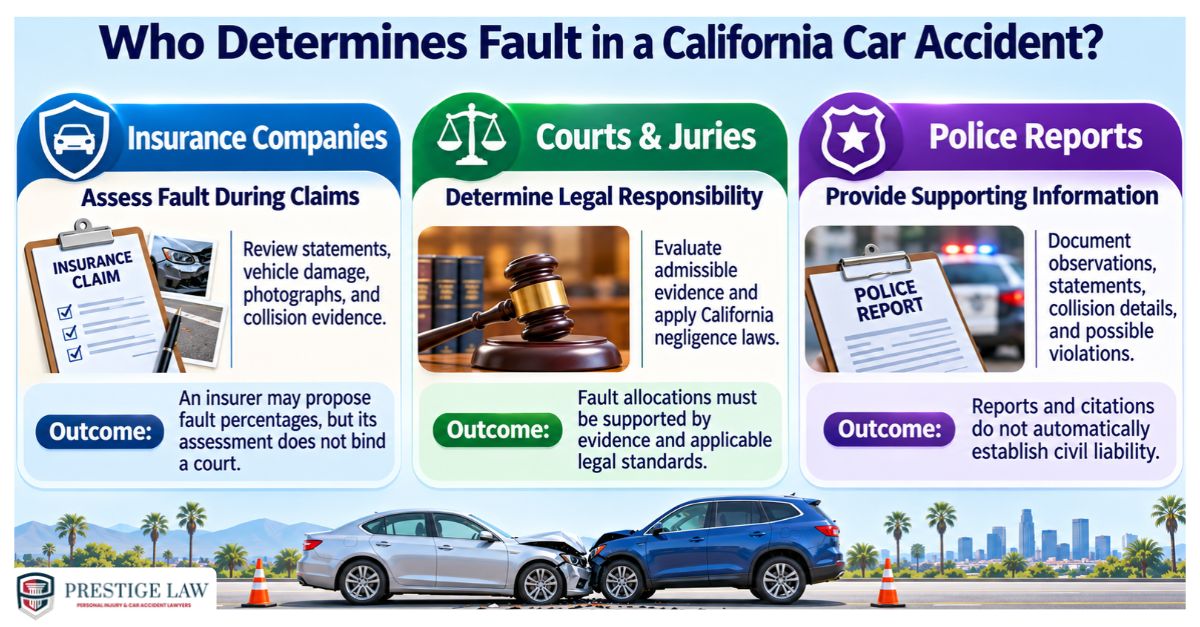
Insurance Companies Make Their Own Assessments
An insurance adjuster may review driver statements, vehicle damage, photographs, collision reports, and other information before proposing a fault percentage.
However, an insurer’s determination does not automatically establish legal responsibility or bind a court.
Different insurers may reach conflicting conclusions, particularly when drivers dispute the sequence of events.
Courts and Juries Evaluate the Evidence
If a dispute proceeds to trial, the court or jury determines the relevant facts and responsibility according to applicable law.
Under CACI No. 405, a defendant asserting comparative negligence must establish that the injured person was negligent and that this negligence was a substantial factor in causing the harm.
A fault percentage should therefore rest on evidence, not simply an allegation that the injured person contributed to the collision.
Does a Police Report Determine Fault?
A collision report may contain important observations, statements, diagrams, or evidence leads, but it does not automatically establish civil liability.
Likewise, receiving a traffic citation does not, by itself, conclusively determine the allocation of fault in a personal injury claim.
The underlying conduct and admissible evidence still matter.
What Evidence Can Help Dispute an Assigned Fault Percentage?
Challenging a fault assessment starts by identifying exactly what conduct the insurer alleges and what evidence supports or contradicts that allegation.
The evidence needed for a disputed left turn may differ from what matters in a rear-end collision or lane-change accident.
Common Fault Disputes and Relevant Evidence
| Disputed Allegation | Evidence That May Help | What It May Clarify |
|---|---|---|
| You Entered an Intersection Against the Signal | Signal Timing Records, Dashcam Footage, Witness Statements | Traffic Signal Sequence and Vehicle Movements |
| You Were Speeding | Available Vehicle Data, Video, Roadway Evidence, Reconstruction Analysis | Possible Speed and Whether It Contributed to the Crash |
| You Changed Lanes Unsafely | Vehicle Damage, Dashcam Footage, Witness Accounts | Vehicle Positions and Lane Movements |
| You Failed to Brake or React | Road Conditions, Video, Vehicle Data, Physical Evidence | Available Reaction Time and Opportunities to Avoid the Collision |
| You Failed to Yield | Intersection Photographs, Traffic Controls, Witness Statements | Applicable Traffic Controls and The Sequence of Events |
Can Accident Reconstruction Help?
In some cases, an accident reconstruction specialist may analyze vehicle damage, collision dynamics, roadway evidence, and available recordings.
Expert analysis is not necessary in every case, and its conclusions depend on the quality of the underlying information.
Additional evidence may support the insurer’s assessment, contradict it, or reveal that more than one driver contributed to the accident.
For related background, see common causes of car accidents and fault evidence.
What If More Than Two People Contributed to the Accident?
Some crashes involve several potentially responsible parties, including multiple drivers or another person or entity whose conduct contributed to the injuries.
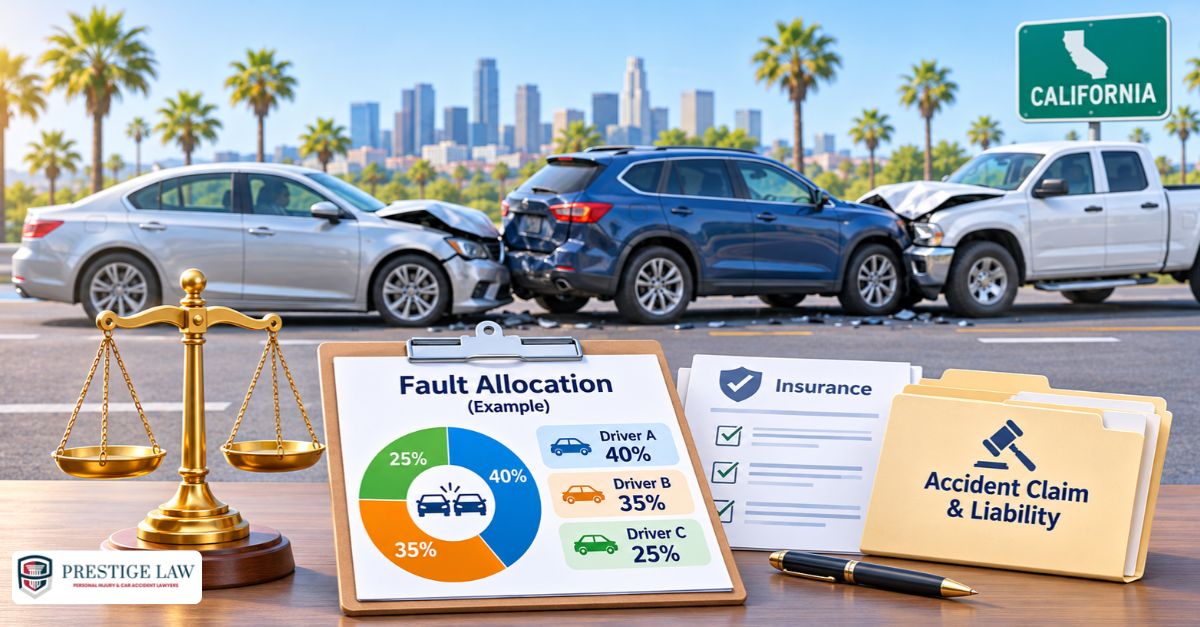
California CACI No. 406 addresses allocating responsibility when multiple parties contributed to the harm.
In an applicable jury determination, responsibility is assigned through percentages that total 100%.
However, allocating fault among several defendants is not the same as applying a simple two-party percentage reduction.
Does Each Defendant Pay the Same Share?
Not necessarily. Under California Civil Code §1431.2, each defendant in a qualifying comparative-fault action is generally responsible only for the noneconomic damages allocated to that defendant according to their percentage of fault.
Economic damages, such as medical bills and lost earnings, generally follow joint and several liability rules. When those rules apply, you may be able to collect the full recoverable amount of your economic damages from one liable defendant. Your own share of fault still reduces the amount you can recover.
This distinction matters when several drivers or parties contributed to the same injuries.
An injured passenger may also have potential claims involving more than one driver. Determining who an injured passenger can sue after a California car accident requires examining each driver’s conduct and other potentially responsible parties, rather than assuming the passenger shares the driver’s fault.
Can You Challenge an Insurance Company’s Fault Assessment?
Yes. An insurer’s preliminary assessment may be reconsidered when additional evidence becomes available or when the existing information does not support its conclusion.
If you disagree with a proposed percentage, consider these steps:
- Request an explanation. Ask which specific actions the insurer believes contributed to the collision.
- Review the evidence. Compare the insurer’s account with photographs, reports, witness information, and other available records.
- Identify missing information. Determine whether relevant video, traffic records, or independent witnesses have been considered.
- Correct factual inaccuracies. Provide accurate information when an important detail has been misunderstood or omitted.
- Consider legal advice. A lawyer can assess the allegation, available evidence, and potential consequences for your claim.
A disputed percentage does not guarantee that the insurer will change its position. However, understanding the factual basis can help you make informed decisions about negotiations.
Frequently Asked Questions About Shared Fault in California
Can an insurer change its initial fault assessment?
Yes. An insurer may revise its assessment after reviewing new evidence, correcting an error, or receiving additional information. However, it is not required to accept your interpretation simply because you disagree. The outcome depends on the evidence and applicable policy and legal requirements.
Does a traffic citation or police report end the dispute?
No. A citation or police report can contain relevant information, but neither automatically settles civil responsibility. The underlying conduct, supporting evidence, and applicable legal standards determine whether a driver was negligent and whether that negligence contributed to the injuries.
What if the other driver was more at fault?
You may be able to recover damages even if you contributed to the crash. California's comparative negligence rule generally reduces recoverable damages according to your own share of responsibility. The amount available can also depend on the evidence, insurance coverage, and other case-specific circumstances.
Discuss a Disputed Fault Assessment With Prestige Law
If an insurer says you were partly responsible for a collision, Prestige Law Firm P.C. can review the circumstances and discuss which evidence may support or challenge that position.
Our California car accident legal help includes evaluating accident evidence, potential liability, and legal options based on the circumstances of each claim.
Disclaimer: This article provides general information about California law and does not constitute legal advice. Fault allocation, damages, insurance coverage, and claim outcomes depend on the circumstances. Contacting the firm does not, by itself, create an attorney-client relationship.
Sources

Get Started Today!
24 hours a day / 7 days a week / 365 days a year
Contact our attorneys serving Los Angeles and the Antelope Valley to schedule your free consultation.