Train Accident Lawyer Los Angeles Prestige Law Firm P.C.




Los Angeles Train Accident Lawyer Focused on Serious Rail Injury Claims
Train accidents are rare, but when they happen, the injuries are often catastrophic and the legal process is far more complex than a typical car accident.
Multiple parties may be responsible, federal safety laws apply, and railroad companies move fast to protect themselves. If you were injured in a train, Metro, Amtrak, freight, or rail-related accident in Los Angeles, you need a law firm that understands the unique laws, procedures, and insurance strategies involved in railroad injury claims.
Prestige Law Firm P.C. represents passengers, workers, drivers, pedestrians, and bystanders injured in train-related crashes throughout Los Angeles County.
We coordinate the legal aspects of claims involving medical treatment, investigations, negotiations, and litigation. Attorney fees are contingent on recovery. Case costs may be advanced and reimbursed from any recovery.


If you were injured in a train accident in Los Angeles, whether as a passenger, pedestrian, driver, rail worker, or bystander, you may have a legal claim for compensation depending on the facts of your case. Train accident cases are more complex than car accidents because they often involve multiple liable parties (railroad companies, contractors, government agencies, manufacturers), federal safety laws, and experienced insurance and defense counsel.
Prestige Law Firm P.C. has more than two decades of experience handling high-value and complex injury claims, and a record of representing clients in claims involving rail companies. We handle the legal process, including claims related to medical treatment, lost income, expert investigations, and litigation.
Unique Legal Complexities in Train Accident Cases
Train accident cases are far more complex than standard car accident claims. They involve higher injury severity, federal safety laws, multiple liable parties, and powerful railroad corporations that immediately begin defending themselves.
That’s why these cases require a lawyer who understands both personal injury litigation and the unique laws that apply to rail systems in California.
How Train Accidents Differ from Car Accidents?
- Train accidents are handled very differently from car accidents because the scale, laws, and parties involved are completely different. While car crashes usually involve two drivers, a police report, and an insurance claim, train accidents can involve dozens of injured passengers, multiple companies, federal investigators, and millions of dollars in damages.
- The main difference starts with the severity of the impact. Trains weigh thousands of tons and travel at high speeds, so when something goes wrong, the results are often catastrophic or fatal.
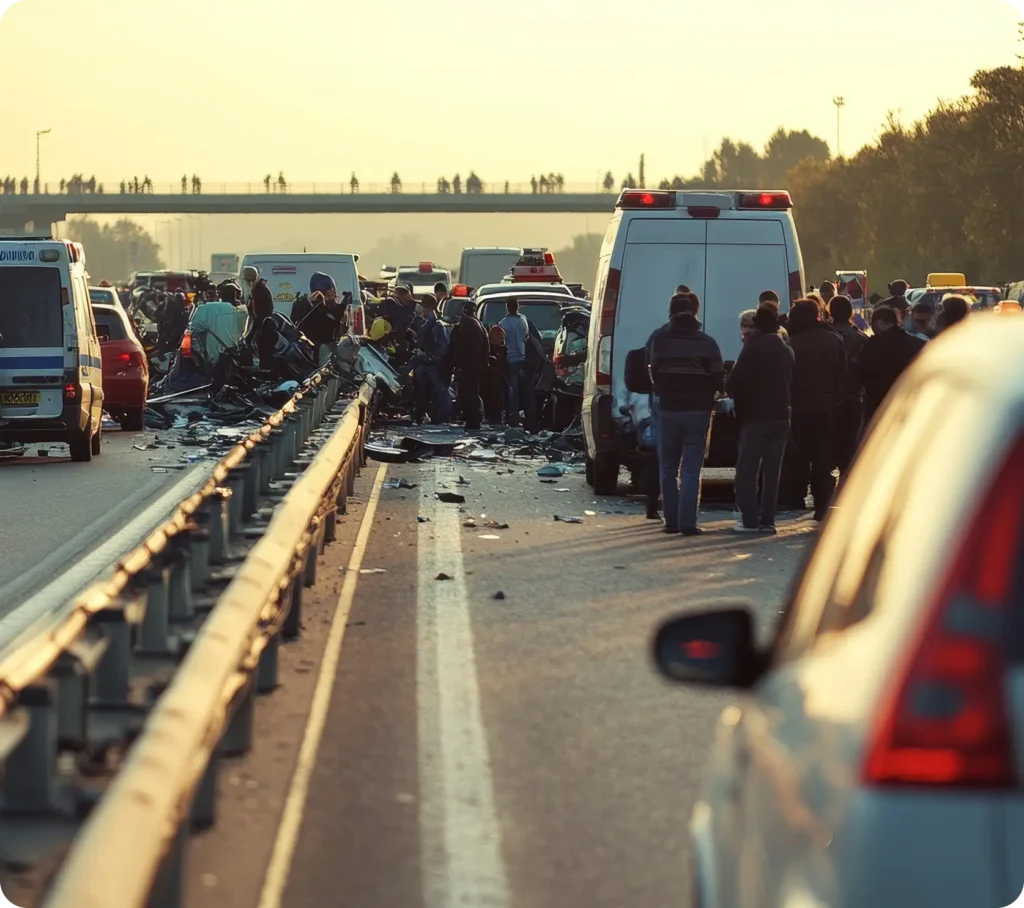
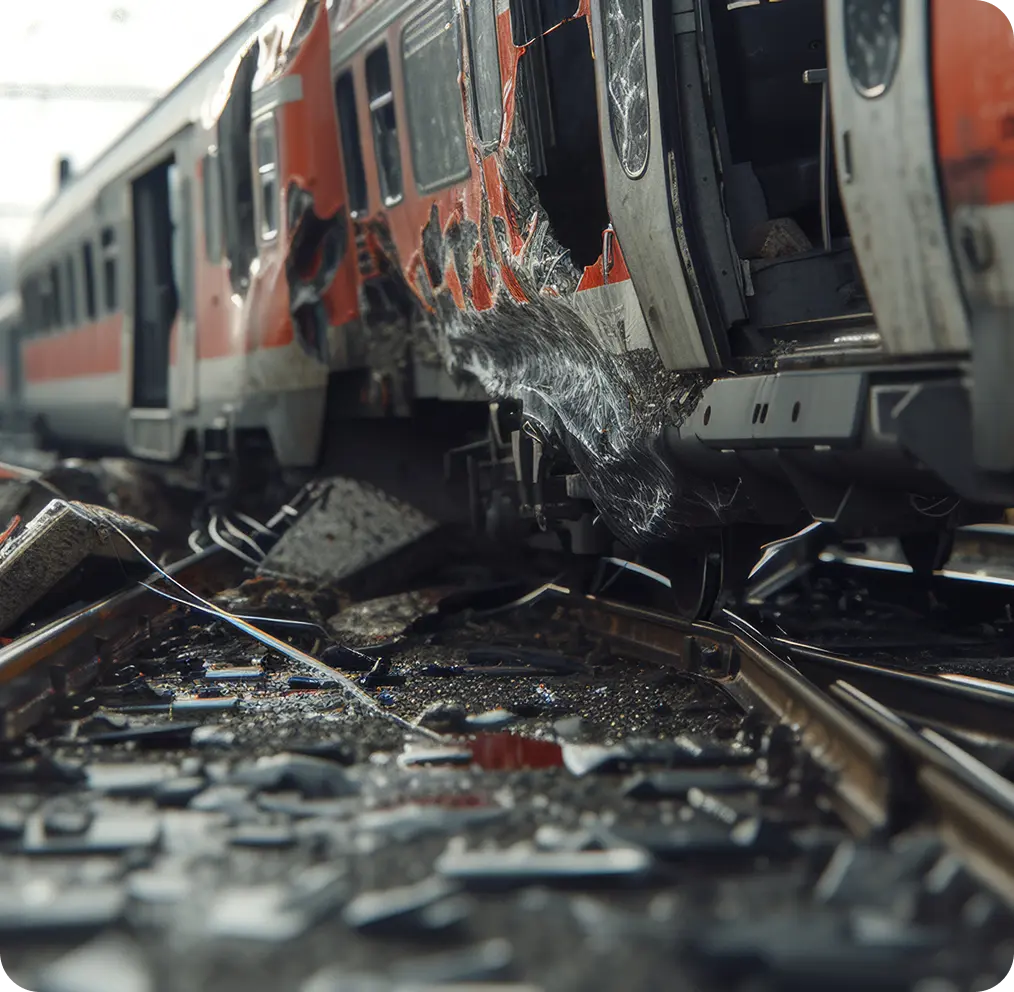
- A single derailment or crossing collision can injure passengers, railroad workers, pedestrians, drivers, and even people in nearby buildings, far beyond the scope of a typical car accident.
- Unlike car accidents, the evidence in a train crash is highly technical. Instead of just photos and witness statements, attorneys must analyze black box data, operator logs, event recorders, signal history, track conditions, federal safety reports, surveillance footage, and maintenance records.
- These cases often require accident reconstruction specialists, engineers, and expert witnesses.

- Liability is also more complex. In a car crash, the at-fault driver is usually obvious. In a train accident, responsibility may fall on the railroad company, the train operator, a maintenance contractor, a parts manufacturer, or even a government agency that failed to maintain a crossing or signal. Multiple lawsuits can result from the same incident.
- Another major difference is that train accident cases are governed by federal railroad laws, not just California traffic rules. Agencies like the FRA and NTSB investigate train crashes, and federal statutes like FELA apply when workers are hurt.
- That means the timeline, investigation, and legal strategy are far more involved than a standard insurance claim after a car accident.
- Car accident claims are usually settled through insurance and often resolve within months. Train accident cases can take years because the injuries, number of victims, and legal issues are much larger and rail companies have defense teams ready the moment a crash occurs.
Federal & State Railroad Regulations Apply
Train accident cases are governed by a complex mix of federal and state safety laws, which do not apply in ordinary car accident claims.
These regulations dictate how trains must be operated, how tracks are maintained, and how crashes are investigated, and they play a major role in proving fault and negligence.
Some of the key laws and agencies involved include:
- FELA (Federal Employers’ Liability Act) : allows injured railroad workers to sue the rail company directly, instead of being limited to workers’ compensation.
- FRA (Federal Railroad Administration) : enforces national safety standards for train operation, inspections, equipment, and operator qualifications.
- CPUC (California Public Utilities Commission) : regulates rail crossings, commuter rail systems like Metrolink, and state-level transit safety.
- NTSB (National Transportation Safety Board) : investigates serious train crashes and publishes official findings that can be used as evidence in lawsuits.
When a railroad company, contractor, or government agency violates any of these rules, it can be used as strong evidence of negligence, which may support a claim for compensation depending on the evidence and applicable law.
Immediate Steps to Take After a Train Accident in Los Angeles
What you do in the minutes and hours after a train accident can make a major difference in your health, your legal rights, and the value of your claim. Even if you feel shocked or confused, following the right steps will protect you and help build a strong case later.
1. Seek Medical Attention
Your health comes first. Get medical care immediately, even if you think your injuries are minor. Many train accident injuries, including concussions, internal bleeding, and spinal damage, don’t show symptoms right away. A medical record also becomes key evidence in your claim.
2. Report the Incident
Make sure the accident is formally documented. Depending on your
- situation, this may include:
- Police or emergency responders
- Railroad personnel on-site
- Your employer (if you were on the job)
Do not leave the scene without ensuring an official report is being filed.
3. Do Not Speak to Railroad Insurance or Claims Adjusters
Rail companies have insurance teams who will try to contact victims quickly to limit their liability. Do not give statements, sign forms, or accept any settlement offers before speaking with a lawyer. Anything you say can be used against you later.
4. Preserve Evidence
If you are physically able, gather as much evidence as possible before the scene is cleared:
- Photos or videos of the accident site, train cars, crossing signs, injuries, and property damage
- Contact information from witnesses or other passengers
- Train number, company name, and names of crew members
Keep all medical records, receipts, transportation tickets, and damaged personal items, they may be used as proof in your claim.
5. When to Consider Speaking With a Train Accident Attorney
Train accidents involve multiple laws, multiple liable parties, and aggressive corporate defense teams. Early legal guidance can help preserve evidence, assess expert needs, and clarify your rights.
Prestige Law Firm P.C. will:
- Handle all communication with rail companies and insurers
- Investigate the cause of the accident
- Secure expert testimony and accident reports
- Assist with the legal process related to medical treatment and claims for financial losses
Evidence may become harder to obtain over time, and insurers often begin their evaluations early. Contact Prestige Law Firm P.C. for a free consultation.
Top Personal Injury Lawyers |
Prestige Law Firm P.C – Get
Justice Today
Injured in a car accident or due to someone else’s negligence? Prestige Law’s experienced injury attorneys are ready to fight for you.
Book your free consultation today and let us help you win the compensation you deserve.

Who Can Be Held Liable in Railroad Accident Claims?
Rail systems involve multiple companies, contractors, government agencies, and equipment providers, which means liability is often shared, and each party will try to avoid blame. A proper investigation is critical to uncover every source of negligence and pursue compensation under California and federal law.
Let’s see who may be held responsible after a train accident and how each one can play a role in causing or preventing a crash.
Railroad Companies / Train Operators
The company running the train is often the first party investigated. They are responsible for:
- Safe operation of the train
- Proper employee training
- Track and equipment maintenance
- Compliance with federal and state safety regulations
If the crash resulted from speeding, operator fatigue, failure to follow safety rules, or poor maintenance, the rail company can be held liable.
Train Engineers & Conductors
If the operator was distracted, impaired, fatigued, or ignored signals, they may be personally at fault, although the employer is still legally responsible under vicarious liability.
Track Owners & Maintenance Contractors
The company operating the train is not always the same company that owns or maintains the tracks. Liability may fall on:
- Track owners
- Signal and crossing maintenance companies
- Third-party contractors responsible for safety inspections
Faulty switches, broken rails, overgrown vegetation, or non-functioning warning lights may point to maintenance negligence.

Manufacturers & Equipment Suppliers
If the accident was caused by a defective part, such as brakes, engine components, coupling systems, or crossing gates, the manufacturer or equipment installer may be liable under product liability law.
Government Agencies & Public Transportation Authorities
If the accident involves a public rail system (like Metro rail, Metrolink, or Amtrak infrastructure), the city, county, or state may share responsibility, especially for unsafe crossings, poor design, or failed warning systems.
Drivers & Vehicle Operators
If a driver failed to operate their vehicle safely, such as ignoring signals or driving recklessly, they may be held liable for contributing to the accident.
Third Parties (Drivers, Businesses, or Property Owners)
Liability may also fall on
- A vehicle owner who stalled or parked on the tracks
- A trucking company blocking a crossing
- A property owner who created a hazard near the tracks
In many cases, multiple defendants are named, which may affect the scope of available compensation, depending on the evidence and law.
The more parties involved, the more insurance coverage is available, but each party will deny fault and blame the others. That’s why a successful train accident claim requires:
- Accident reconstruction experts
- Review of black box data and operator logs
- Federal and state safety law analysis
- Early legal involvement to help preserve evidence

Common Injuries Resulting from Train Accidents and Their Impact
Unlike typical Because of the sheer size, speed, and force of a train, even a minor collision can lead to severe, life-altering injuries. Victims are often left facing long-term medical treatment, permanent disability, psychological trauma, and an overwhelming financial burden.
car accident injuries, train accident injuries are far more likely to be catastrophic, meaning they permanently affect a person’s ability to work, function, or live independently.
Serious Physical Injuries Frequently Seen in Train Accidents
Train accident victims commonly suffer from:
- Traumatic Brain Injuries (TBI) : from concussions to severe brain damage, often requiring lifelong care and impacting memory, mobility, and cognitive function.
- Spinal Cord Damage & Paralysis : nerve damage, loss of sensation, paraplegia or quadriplegia, and long-term loss of mobility.
- Crushed or Fractured Bones : often requiring multiple surgeries, metal implants, and months of rehabilitation.
- Amputations : caused by crushing injuries or emergency surgical removal of damaged limbs.
- Internal Organ Damage & Internal Bleeding : dangerous and often not immediately visible without medical imaging.
- Severe Burns, Scarring & Disfigurement : commonly seen in derailments, fires, or high-impact collisions.
- Lacerations & Soft Tissue Injuries : torn ligaments, nerve damage, and muscle trauma that may never fully heal.

Top Personal Injury Lawyers |
Prestige Law Firm P.C – Get
Justice Today
Injured in a car accident or due to someone else’s negligence? Prestige Law’s experienced injury attorneys are ready to fight for you.
Book your free consultation today and let us help you win the compensation you deserve.

The Role of Railroad Companies and Contractors in Liability
Railroad companies and the contractors they hire play a central role in keeping trains, tracks, and stations safe for passengers, railway workers, and the public.
Under the law, they owe a high duty of care, meaning they are legally required to operate trains safely, maintain equipment, follow inspection protocols, and comply with federal and state safety regulations.
When they fail to meet these standards, they can be held financially responsible for the injuries and losses that follow.
Duty of Care Owed to Passengers, Workers, and the Public
Rail operators and their contractors must:
- Properly train engineers, conductors, and crew
- Inspect and maintain tracks, signals, and braking systems
- Monitor operator fatigue, speed, and compliance with safety rules
- Secure platforms, stations, and railroad crossings
- Repair or replace unsafe or defective equipment
- Follow federal regulations set by the FRA, CPUC, and NTSB
Whether you’re a paying passenger, a railroad employee, or a driver crossing a public rail line, the company has a legal responsibility to protect you from preventable harm.

How Negligence Is Proven in Train Accident Cases?
To hold a railroad company accountable, a legal investigation must show:

Duty of Care
In every train accident case, the first legal question is whether the railroad company or involved party owed a duty of care. Because railroads are classified as common carriers, they are held to one of the highest safety standards under the law. That means they must take every reasonable step to protect passengers, employees, and the public. This duty includes properly training operators, maintaining tracks and trains, inspecting equipment, following federal safety regulations, and providing warnings at crossings.
When a rail company operates in a way that puts people at risk, the law recognizes that they have failed the duty of care they are legally required to uphold.
Breach of Duty
Once the duty of care is established, the next step is proving that the railroad company or another responsible party breached that duty. A breach happens when a company or individual fails to act as a reasonably careful and qualified professional would under the same circumstances.
In train accident cases, this may include skipping inspections, ignoring safety warnings, allowing fatigued engineers to operate trains, neglecting track maintenance, or failing to repair damaged signals.
When these failures lead to unsafe conditions, the party responsible can be considered negligent, even if the act was not intentional.
Causation
After proving a breach, the law requires a direct link between the negligence and the accident itself. This element, called causation, shows that the unsafe act or failure to act is what actually caused the crash and the resulting injuries.
Proving causation often requires expert investigation, black box data, maintenance logs, video footage, and testimony from engineers or safety specialists.
Actual Damages
Even if negligence is proven, a case cannot succeed unless the victim can show actual, measurable harm. Damages may include medical bills, lost income, long-term disability, pain and suffering, emotional trauma, or in severe cases, funeral costs and loss of financial support in a wrongful death claim.
These damages must be supported with documentation such as medical records, wage statements, expert evaluations, and future care estimates. In many cases, the long-term financial impact, surgeries, rehabilitation, assistive devices, or job loss, is greater than the immediate medical bills, which is why proper calculation of damages is essential.
Need to Know What Your Case Is Worth?
Every train accident injury is different and so is every settlement. A legal review can help estimate the potential value of a claim based on available information.
Call Prestige Law Firm P.C. today for a free case evaluation. No upfront fees. No obligation.
Discussing Your Legal Options After a Train Accident
If you or a loved one has been injured in a train accident, you don’t have to deal with the railroad company, insurance adjusters, or legal deadlines. Early legal guidance can help preserve evidence, clarify your rights, and assess available legal options.
Have questions about your claim?
Wondering what your case is worth?
Not sure if you even need a lawyer yet?
Let’s talk, the consultation is free, and you’ll speak directly with an attorney, not a call center.
Contact Prestige Law Firm P.C.

Visit or call one of our Los Angeles area offices:
Sherman Oaks
- 818-788-0808
- 14541 Sylvan Street Van Nuys, CA 91411
- info@prestigelaw.com
Encino
- 818-425-9815
- 15915 Ventura Blvd. Penthouse 5\Encino,CA 91436
- info@prestigelaw.com
Palmdale
- 661-341-3939
- 1043 W. Ave M-4 Suite B, Palmdale, CA 93551
- info@prestigelaw.com
What Our Client Say About Us
-
Thank you Prestige law firm. They are great at communicating and providing updates. Thank you Mr. Paul and Team.
-
Estoy muy agredecido con Paul. El abogado Paul me ayudo con mi caso. Recomiendo a esta firma porque son muy professionales y se preocupan de sus clientes. Muchas gracias Prestige law.
-
Fue muy buena, y me atendieron de inmediato y siempre al pendiente de lo que se necesitaba para que mi caso fuera lo mejor posible, el abogado muy bien y todo el personal de oficina amables y al pendiente de todo, fue una experiencia muy buena. Muchas gracias. Atte. DANIEL GARCIA BALDERAS.
-
I’d like to sincerely thank Paul Aghabala and the Prestige Law firm for all of their time and hard work. I was a scared kid when I reached out and they helped me through the hardest time in my life. They truly fought for me. Thank you!
-
It has been a pleasure dealing with Paul and his associates. They genuinely care about you and your case. They are knowledgeable, honest and caring about you and your progress. Thank you for your service. I will definitely be back.
-
Awesome firm to handle my car accident! I got rear ended last year on Valentine’s Day 2024 and that was a bummer. After being referred to this team of professional attorneys they handled my case with care and continuous communication through all of my medical care. I felt they did their job with integrity and I would recommend them if you’re ever in a car accident. Thanks Prestige!
-
Prestige Law son un grupo de Abogado’s Que me ayudaron a obtener lo Maximo en llevar mi caso de accidente
-
Maravillosos mi caso ya esta cerrado con muy buenas ganancias para mi. Super recomendados.
-
I never in a million years thought that I would be one of those people to get hit in the rear it was totally devastating and I had no idea what to do. I made contact with the prestige law firm and they totally put me at ease not only did they get me Immediate medical attention and help with my aches and pains they got me a settlement that was beyond my wildest dreams I will always be grateful to them. I hope I’m never in another accident but if I am I will definitely be calling the prestige Law Firm


FAQ
How long do I have to file a train accident lawsuit in California?
Do I need a lawyer, or can I deal with the insurance company myself?
What if the train accident was partly my fault?
Will I have to go to court?
What if the insurance company already offered me a settlement?
Get Started Today!
24 hours a day / 7 days a week / 365 days a year
Contact our Los Angeles and Antelope team of attorneys for a free consultation.