
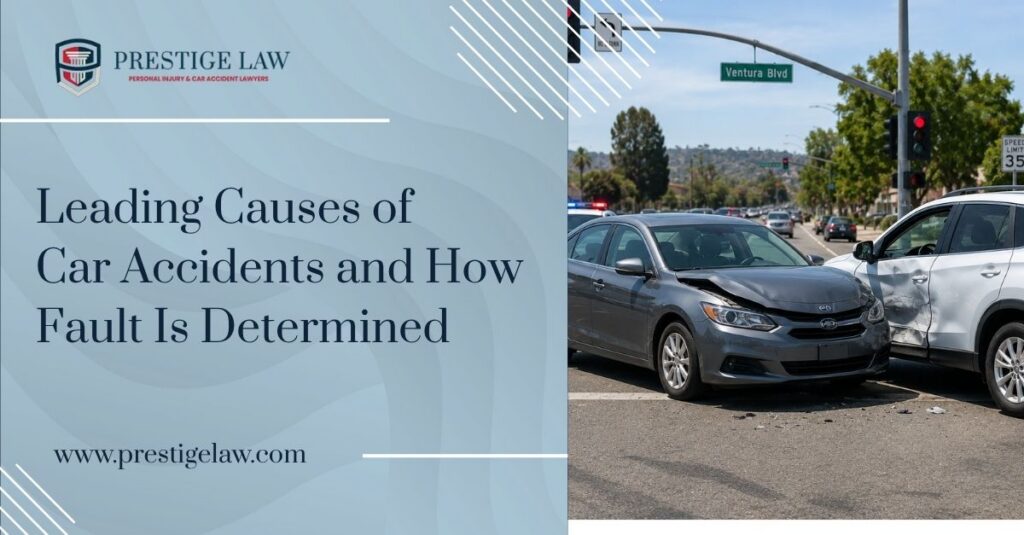
Common Causes of Car Accidents in California
Published on / Category: Accident Injuries & Recovery
Car accidents rarely occur without an identifiable cause. Most crashes result from a specific action, decision, or condition that leads to a moment of impact.
In California, understanding what caused a car accident is essential because fault, insurance responsibility, and legal liability are based on how and why the collision happened.
Many collisions are linked to behaviors such as distracted driving, speeding, impaired driving, or aggressive driving. Others stem from external factors like unsafe road conditions or mechanical failures. These causes are not just traffic issues. They form the foundation of how negligence is evaluated under California law and how insurance companies assess responsibility for injuries and damages.
Recognizing the underlying cause of a crash helps injured drivers and families understand how fault is determined, why insurance disputes arise, and when legal guidance may be necessary.
A clear understanding of accident causes also helps preserve critical evidence and avoid common mistakes that can affect a claim after a collision.
At a Glance:
Most car accidents in California are caused by identifiable factors such as distracted driving, speeding, impaired driving, aggressive behavior, unsafe road conditions, or vehicle defects. Determining who is legally responsible depends on whether a driver or another party breached their duty of care and whether that breach caused the crash and resulting injuries. Police reports, witness statements, vehicle data, and technical analysis are commonly used to identify the cause of an accident. When fault is unclear, shared, or disputed, understanding how negligence works can help injured drivers make informed decisions about insurance claims and next steps after a collision.
Most Common Causes of Car Accidents
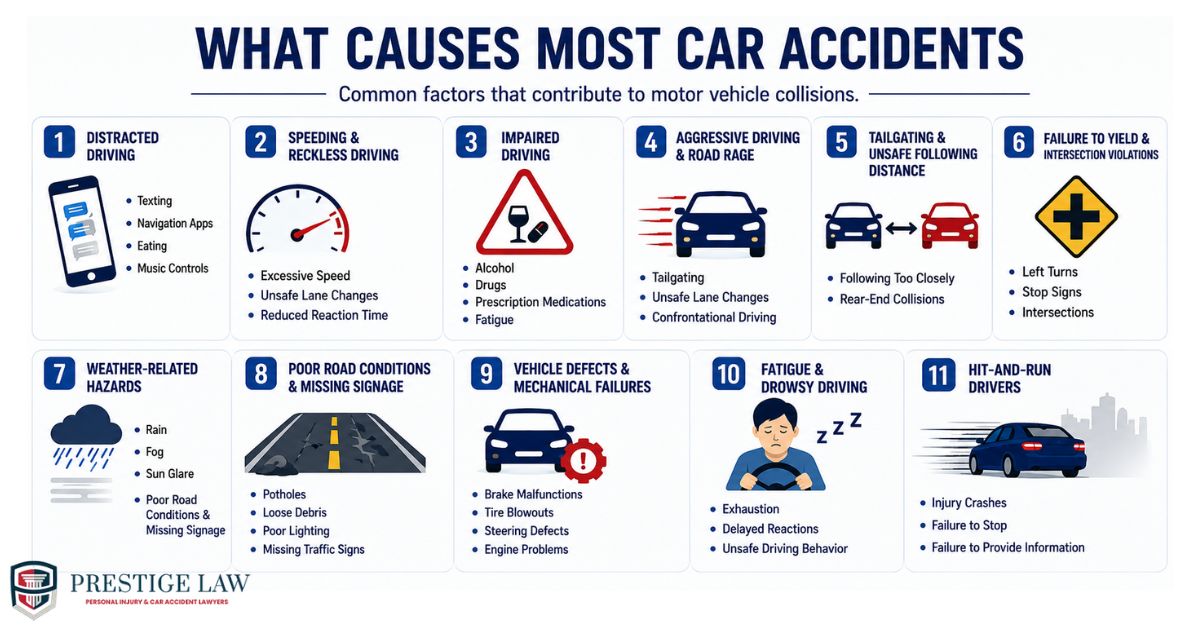
Below are the most common causes of car accidents, explained with real-world context and legal relevance under California law.
Distracted Driving
Distracted driving occurs when a driver’s attention is diverted away from operating the vehicle safely. Common distractions include texting, using navigation apps, eating, adjusting music controls, or interacting with passengers.
California law directly addresses this behavior under California Vehicle Code §23123.5, which prohibits handheld electronic device use while driving.
In real-world situations, distracted driving frequently leads to rear-end collisions in traffic or intersection crashes where a driver fails to notice traffic signals, stopped vehicles, or pedestrians. From a legal standpoint, distraction often establishes a clear breach of duty, as drivers are expected to remain attentive to roadway conditions at all times.
Even brief lapses in attention can be enough to support a finding of negligence if they result in a collision.
Speeding and Reckless Driving
Speeding significantly increases both the likelihood and severity of accidents, including crashes that result in catastrophic injuries. Higher speeds reduce a driver’s ability to react to sudden changes in traffic and increase stopping distance.
Under California Vehicle Code §22350, also known as the Basic Speed Law, drivers must travel at a speed that is reasonable and safe for current road, traffic, and weather conditions, even if they are driving below the posted speed limit.
Speed-related crashes are common on freeways, major surface streets, and arterial roads throughout Los Angeles County. In Los Angeles, high-traffic corridors such as the I-5, I-10, US-101, SR-14, and I-405 frequently see collisions involving speeding, distracted driving, and unsafe lane changes, particularly during peak commuting hours.
In liability analysis, excessive speed often demonstrates negligence by showing that the driver lacked sufficient control to avoid the collision.
Impaired Driving (Alcohol, Drugs, Prescription Medications)
Impaired driving includes operating a vehicle under the influence of alcohol, illegal drugs, prescription medications with sedative effects, or extreme fatigue.
California Vehicle Code §23152 prohibits driving while impaired by alcohol or drugs.
While impaired driving can lead to criminal charges, it also has serious implications in civil injury cases. Criminal prosecution focuses on punishment, while civil claims focus on responsibility for injuries and losses. Evidence of impairment often strengthens causation arguments because it directly explains delayed reactions, poor judgment, or loss of vehicle control that led to the crash.
Aggressive Driving & Road Rage
Aggressive driving involves behaviors such as tailgating, unsafe lane changes, excessive speeding, and confrontational actions toward other drivers.
These behaviors often violate multiple traffic laws, including California Vehicle Code §22107, which requires drivers to ensure lane changes can be made safely.
In accident cases, aggressive driving can demonstrate a heightened level of negligence because it shows conscious disregard for the safety of others. Road rage incidents may also affect liability analysis when intentional or reckless conduct contributes to the collision.
Tailgating and Unsafe Following Distance
Following too closely is one of the most frequent causes of rear-end accidents in California. California Vehicle Code §21703 requires drivers to maintain a reasonable and prudent following distance based on speed, traffic, and road conditions.
Rear-end collisions often create a presumption of fault against the trailing driver, especially when there is no evidence of sudden or unavoidable stopping.
Insurers and investigators commonly rely on this presumption when assigning liability, making tailgating a central issue in many claims.
Failure to Yield & Intersection Violations
Failure-to-yield accidents are common at intersections, during left turns, and at stop-controlled or signalized crossings. Relevant statutes include California Vehicle Code §21801 for left turns and §22450 for stop sign compliance.
Intersections are among the most dangerous areas on the road because collisions often involve side impacts, which can result in serious injuries.
From a legal perspective, failure to yield is a direct traffic violation that frequently establishes negligence when it leads to a crash.
Weather-Related Hazards
Rain, fog, and sun glare contribute to many accidents across California, particularly during seasonal weather changes. However, adverse weather does not excuse unsafe driving behavior.
Under Vehicle Code §22350, drivers are required to adjust speed and driving behavior to account for reduced visibility or traction.
Accidents occurring in poor weather conditions often still involve driver fault when the driver failed to slow down, increase following distance, or maintain control of the vehicle.
Poor Road Conditions & Missing Signage
Road hazards such as potholes, loose debris, uneven pavement, poor lighting, or missing traffic signs can contribute to serious accidents.
While drivers must still adjust their behavior under California Vehicle Code §22350 to account for road conditions, some crashes are caused by hazards that drivers could not reasonably avoid.
In these cases, liability may extend beyond individual drivers. Under California Government Code §835, a public entity may be responsible if a dangerous condition of public property created a foreseeable risk of injury and the agency knew, or should have known, about the hazard but failed to repair it or provide adequate warning.
Establishing this type of claim typically requires evidence showing the condition existed long enough for corrective action to have been taken.
Vehicle Defects & Mechanical Failures
Mechanical failures such as brake malfunctions, tire blowouts, steering defects, or engine problems can cause drivers to lose control of their vehicles. Determining liability depends on the source of the failure.
- Maintenance-related failures may place responsibility on the vehicle owner or operator.
- Manufacturing or design defects may implicate vehicle or parts manufacturers under product liability law.
- Distinguishing between these causes is essential to identifying the correct responsible party.
Fatigue and Drowsy Driving
Fatigue impairs reaction time, attention, and decision-making in ways comparable to alcohol impairment. Drowsy driving is particularly common among delivery drivers, construction workers, and individuals working long or irregular shifts.
Although there is no single statute dedicated solely to fatigue, drivers may still be found negligent if exhaustion contributed to delayed reactions or unsafe driving behavior that caused a collision.
Hit-and-Run Drivers
Hit-and-run accidents are common in busy urban areas throughout Los Angeles County. California Vehicle Code §20001 requires drivers involved in injury crashes to stop and provide identifying information.
Even when a driver leaves the scene, identifying the cause of the accident remains important. Establishing how the crash occurred can affect uninsured motorist claims, third-party liability, and the overall handling of insurance coverage.
Understanding Negligence in Car Accident Cases
Most car accident injury claims in California are based on negligence rather than intentional wrongdoing. Negligence focuses on whether a driver failed to act with reasonable care and whether that failure caused harm.
To establish negligence, four legal elements must be present. Each element builds on the next, and all must be shown for liability to exist.
Duty of Care
Every driver on the road owes a duty of care to others. This means operating a vehicle in a reasonably safe manner to avoid causing harm to other drivers, passengers, pedestrians, bicyclists, and property. Drivers accept this responsibility the moment they get behind the wheel.
Duty of care includes following traffic laws, obeying signals and signs, maintaining a safe speed, staying alert, and using basic safety measures such as turn signals and headlights. Traffic laws are essentially formal rules that define what safe and reasonable driving looks like in everyday situations.
Breach of Duty
A breach of duty occurs when a driver fails to meet the standard of care expected of a reasonable person under similar circumstances.
This can involve doing something unsafe, such as speeding or texting while driving, or failing to do something a cautious driver would do, such as slowing down for traffic or yielding at an intersection.
Courts and insurance companies often apply the “reasonable driver” standard when evaluating a breach. If a reasonable driver would have acted differently in the same situation, the duty of care may be considered breached.
Traffic citations, witness statements, and video evidence can help show that a driver violated traffic rules or acted recklessly.
Causation
Causation connects the unsafe behavior to the crash and resulting injuries. It must be shown that the driver’s breach of duty directly caused the accident and that the harm would not have occurred without that conduct.
Causation is often examined in two parts. Cause-in-fact asks whether the collision would have happened if the driver had acted safely.
Proximate cause looks at whether the injuries were a foreseeable result of the driver’s actions. For example, running a red light and striking a vehicle in an intersection establishes a clear link between the violation and the crash.
Damages
Damages refer to the actual losses suffered as a result of the accident. These may include medical treatment costs, lost income due to missed work, and property damage to a vehicle or other belongings.
Damages can also include non-economic harm, such as pain, discomfort, or reduced quality of life. Without measurable harm, a negligence claim cannot proceed, even if a driver acted carelessly.
Establishing damages completes the legal framework required to evaluate responsibility in a car accident case.
How the Cause of a Car Accident Is Determined

Determining the cause of a car accident involves more than identifying who was involved. Investigators and insurers analyze multiple sources of evidence to understand how the collision occurred and whether negligence played a role.
Each type of evidence serves a different purpose and helps build a clearer picture of events leading up to the crash.
Police Reports
Police reports are often one of the first pieces of documentation created after a car accident.
They provide an official snapshot of what was observed and reported at the scene. A typical police report may include:
- Date, time, and location of the collision
- Names and contact information of drivers, passengers, and witnesses
- Statements from the involved parties and any witnesses
- A diagram or description of vehicle positions and points of impact
- The responding officer’s observations and notes
- Any citations or violations issued at the scene
While police reports are an important starting point, they do not make final legal determinations of fault.
An officer’s conclusions are not binding, and insurance companies and courts often rely on additional evidence, such as witness testimony, physical evidence, and expert analysis, to determine how and why the accident occurred.
Eyewitness Statements
Eyewitness statements provide independent accounts from individuals who observed the collision. These statements can help confirm key details such as vehicle positions, traffic signal status, speed, and driver behavior immediately before impact.
Because witnesses are not directly involved in the accident, their observations can add credibility to a claim. Consistent witness accounts are often used to corroborate physical evidence and clarify disputed facts.
Cell Phone Records
Cell phone records are frequently examined in cases involving suspected distracted driving.
These records can show whether a driver was texting, calling, or using data at or near the time of the crash.
When aligned with crash timing, phone records can help establish whether a driver was distracted in the moments leading up to the collision.
This type of evidence can be especially important when there are no witnesses or when driver accounts conflict.
Accident Reconstruction
Accident reconstruction is a scientific process used to determine how a crash occurred by analyzing physical and technical evidence. Reconstruction experts may review:
- Skid marks and braking patterns
- Vehicle damage and impact points
- Debris location and roadway conditions
- Final resting positions of the vehicles
Based on this analysis, experts can estimate factors such as vehicle speed, braking activity, and angles of impact. Their findings are commonly used to clarify disputed events and support conclusions about the cause of a collision.
Vehicle Black-Box (EDR) Data
Many modern vehicles are equipped with Event Data Recorders (EDRs), commonly referred to as black boxes. These devices record critical information in the seconds before a crash, including vehicle speed, braking activity, throttle position, and steering inputs.
EDR data provides objective insight into how a vehicle was being operated just before impact.
When available, this information can be used to confirm or challenge driver statements and strengthen the overall analysis of how the accident occurred.
When the Other Driver Isn’t the Only One at Fault
In some car accidents, causes extend beyond the actions of another driver. Under California law, other parties may share responsibility when their conduct, omissions, or products contribute to a crash.
Below are common examples of non-driver liability and how they may factor into legal and insurance claims.
Government or Municipality Liability

Public agencies responsible for roadways have a duty to maintain reasonably safe conditions.
When dangerous road design, poor maintenance, or missing traffic controls contribute to an accident, a government entity may be liable.
California Government Code §835: A public entity can be responsible for injuries caused by a dangerous condition of public property if:
– The condition created a foreseeable risk of injury, and
– The entity had actual or constructive notice of the hazard and failed to take corrective action or provide warning.
Common examples include:
- Unmarked or obscured traffic signals
- Large potholes or broken pavement
- Inadequate guardrails or lighting
Government liability claims have strict notice and timetable requirements. Evidence such as maintenance records, prior complaints, or traffic studies may be necessary to show the agency knew or should have known about the hazard.
Vehicle Manufacturer Liability
Accidents caused by defective vehicle parts or design flaws may create liability for manufacturers, designers, or parts suppliers. These claims fall under product liability principles.
Defects that can contribute to crashes include:
- Faulty brakes or steering systems
- Tire blowouts due to manufacturing flaws
- Electronic stability systems that fail unexpectedly
In product defect claims, courts examine whether:
– The design or manufacturing defect made the vehicle unreasonably dangerous, and
– The defect was a substantial factor in causing the crash and injuries.
Unlike driver negligence, product defect liability does not depend on proving careless behavior; rather, it focuses on whether the product met accepted safety standards and whether a safer design was feasible.
Employer or Commercial Liability

When a crash involves a delivery driver, commercial vehicle, or employee operating a vehicle for work purposes, an employer may share liability under the legal doctrine of respondeat superior.
Respondeat superior holds employers responsible for the actions of employees when:
– The employee was acting within the scope of employment, and
– The wrongful act occurred during work-related duties.
Examples include:
- A delivery driver causing a collision while making work stops
- A company vehicle operated without proper safety checks
- Employers who fail to enforce rest breaks or safe driving policies
In these situations, both the individual driver and the employer may be named in claims. Insurers often investigate employment logs, delivery routes, and company policies to determine whether the crash occurred during work activities.
What to Do If Your Accident Was Caused by Negligence
After a car accident, early decisions can significantly affect how a claim is evaluated. Taking the right steps helps protect your health and preserves evidence that may be necessary to show how the collision occurred and who may be responsible.

Steps to Protect Your Claim
Certain actions should be taken as soon as possible after a crash to reduce disputes over fault and damages.
Seek Medical Attention
Obtain medical care promptly, even if injuries seem minor. Medical records help document the connection between the accident and your injuries.
Report the Crash
Contact law enforcement and ensure an official report is made. A documented accident report creates an objective record of the incident and the conditions at the scene.
Avoid Recorded Insurance Statements
Insurance companies may request recorded statements shortly after the crash. Providing statements before understanding the cause of the accident or the extent of injuries can create inconsistencies that are later used to challenge a claim.
Some drivers may also suggest resolving the matter privately without involving insurance.
Before agreeing to an out-of-pocket settlement, it is important to understand the potential legal and financial risks.
Evidence Injured Drivers Should Preserve
Preserving evidence early helps support how the accident occurred and the losses that followed.
- Photos or videos of vehicle damage, roadway conditions, and visible injuries
- Contact information for witnesses and other involved parties
- Repair estimates, towing receipts, and vehicle inspection records
- Medical paperwork and appointment documentation
This information can become critical if fault is disputed or if the claim progresses beyond an initial insurance review.
When Speaking With a Lawyer May Help
Legal guidance may be useful when the cause of the accident is unclear or when insurance issues arise.
- Clarifying fault: Reviewing evidence to determine how negligence may have contributed to the crash.
- Managing insurance disputes: Addressing denied, delayed, or undervalued claims.
- Coordinating medical documentation: Ensuring treatment records accurately reflect accident-related injuries.
Understanding these steps can help injured drivers make informed decisions while navigating the aftermath of a negligence-related car accident.
How Prestige Law Firm P.C. Investigates Accident Causes

Determining the cause of a car accident requires a methodical and evidence-driven approach.
Prestige Law Firm P.C. car accident lawyers in LA focus on building a clear factual record by examining how a collision occurred and identifying all contributing factors.
This investigative process is designed to support accurate fault analysis and informed discussions with insurance carriers.
Detailed Case Investigation
Each case begins with a thorough review of the available evidence surrounding the crash. This may include examining police reports for initial observations and timelines, reviewing surveillance or traffic camera footage when available, and documenting roadway conditions such as signage, lighting, or surface defects.
Witness interviews are also used to clarify disputed facts and confirm how events unfolded before and during the collision.
Technical Evidence Analysis
In cases involving disputed liability or serious injuries, technical evidence can provide objective insight into vehicle operation and driver behavior.
This may involve reviewing cell phone data to assess possible distraction, analyzing vehicle black-box (EDR) information for pre-crash speed and braking activity, and consulting accident reconstruction experts to evaluate impact dynamics and causation. These tools help align physical evidence with the sequence of events.
Insurance Negotiation and Litigation Readiness
Once the cause of the accident is established, the findings are used to address insurance claims that may be denied, delayed, or minimized. Prestige Law Firm P.C. approaches negotiations with supporting documentation and technical analysis, while remaining prepared to escalate disputes if necessary.
Litigation readiness ensures that evidence is preserved and organized should formal proceedings become required to resolve contested liability issues.
Conclusion
Understanding the cause of a car accident is essential to determining fault, insurance responsibility, and whether negligence was involved. Most collisions can be traced to specific actions or conditions, and identifying those causes early can help prevent disputes and confusion during the claims process. A clear, evidence-based approach is especially important when liability is questioned or when more than one party may share responsibility.
Prestige Law Firm P.C. represents injured clients throughout Los Angeles County, including Encino, Van Nuys, Palmdale, Sherman Oaks, Reseda, Northridge, Lancaster, Quartz Hill, and surrounding communities. The firm focuses on carefully investigating how accidents occur and addressing insurance issues that arise after a crash.
If you were injured in a car accident and need help understanding what caused it or how fault may be determined, you can contact Prestige Law Firm P.C. to discuss your situation:
- Encino: 818-425-9815
- Van Nuys: 818-788-0808
- Palmdale: 661-341-3939
Speaking with an attorney familiar with local roads, insurers, and California negligence law can help you better understand your options and next steps after a car accident.
How is fault determined after a car accident?
Fault is determined by reviewing evidence such as police reports, witness statements, vehicle damage, traffic laws, and whether a driver breached their duty of care.
Can more than one party be at fault for a car accident?
Yes. California follows a comparative negligence system, which allows fault to be shared between multiple parties, including drivers, employers, manufacturers, or government entities.
Does a police report decide who is at fault?
No. Police reports are important evidence, but they do not make final legal determinations of fault. Insurance companies and courts consider additional evidence.
What qualifies as distracted driving under California law?
Distracted driving includes activities such as texting, handheld phone use, adjusting GPS, eating, or any action that diverts attention from driving.
How does speeding affect liability in a car accident?
Speeding can demonstrate negligence by showing that a driver could not safely react to traffic conditions, even if they were driving below the posted speed limit.
Can bad road conditions cause a car accident claim?
Yes. If poor road design, maintenance failures, or missing signage contributed to the crash, a government entity may share responsibility in certain cases.
What if a vehicle defect caused the accident?
If a defective part or design flaw contributed to the crash, liability may extend to the vehicle manufacturer or parts supplier under product liability law.

Get Started Today!
24 hours a day / 7 days a week / 365 days a year
Contact our Los Angeles and Antelope team of attorneys for a free consultation.