
Crash-Prone Intersections in Los Angeles: Risks, Causes, and Safety Tips
Published on / Category: Community Issues & Trends
Los Angeles is known for heavy traffic, complex roadway design, and some of the busiest intersections in the country. Every day, drivers, pedestrians, cyclists, delivery workers, and rideshare operators move through crossings where a single mistake, missed signal, or unsafe turn can lead to serious injuries.
Certain intersections repeatedly appear in crash data due to traffic volume, turning conflicts, speeding, pedestrian exposure, and red-light running. These conditions increase the likelihood of serious collisions for drivers, cyclists, and pedestrians alike.
The sections below identify Los Angeles intersections that stand out as crash hotspots, explain what makes these locations hazardous, and highlight practical ways to navigate them more safely. They also outline what steps matter most after an intersection crash, including medical care, evidence preservation, insurance considerations, and situations where legal support may become important.
At a Glance:
Certain intersections in Los Angeles experience repeat crashes due to high traffic volume, wide multi-lane designs, frequent left turns, red-light running, and heavy pedestrian activity. Understanding where these hotspots are and why collisions happen can help drivers, pedestrians, and cyclists reduce risk. When an intersection crash leads to injuries, disputed fault, or insurance issues, knowing the right steps to take, and where to find local guidance, can make the aftermath easier to navigate.
Major Intersection Crash Hotspots Across Los Angeles
The intersections below stand out based on collision counts reflected in publicly available crash data, combined with roadway design and traffic behavior patterns commonly associated with serious accidents. The rankings also consider factors linked to severe crashes, including pedestrian exposure, multi-lane roadway design, turning conflicts, congestion patterns, and reported injury severity.
The list highlights where crashes occur most frequently, followed by brief risk profiles explaining the types of collisions commonly associated with each intersection, what contributes to the elevated risk, and which road users are most affected.
Intersection #1 — Figueroa Street & Slauson Avenue (South Los Angeles)
Figueroa Street and Slauson Avenue ranks as one of the highest-collision intersections identified in Crosstown’s analysis of LAPD crash data. The intersection has been associated with repeated serious crashes, including severe injury collisions, pedestrian incidents, and hit-and-run activity over the reviewed reporting period.
Risk is elevated by heavy traffic volume, proximity to the 110 Freeway, wide roadway design, turning movements, and pedestrian exposure. Drivers entering from freeway-adjacent corridors, pedestrians in crosswalks, and vehicles moving through high-volume traffic face significant risk at this location.
Intersection #2 — Sepulveda Boulevard & Roscoe Boulevard (San Fernando Valley)
Sepulveda Boulevard and Roscoe Boulevard ranks second in the dataset and is one of the busiest high-risk crossings in the San Fernando Valley.
Collisions at this intersection are often associated with heavy congestion, turning conflicts, stop-and-go traffic conditions, and side-impact crashes during busy travel periods. Risk is elevated due to extremely high daily traffic volume, wide multi-lane approaches, frequent turning movements, and long queues during peak hours.
Drivers making left turns and commuters in stop-and-go traffic face the greatest exposure, while pedestrians crossing the wide intersection are also at increased risk.
Intersection #3 — Figueroa Street & Manchester Avenue (South Los Angeles)
The intersection of Figueroa Street and Manchester Avenue in South Los Angeles consistently records a high number of collisions, including serious injury crashes.
Collisions at this intersection are often associated with turning conflicts, signal violations, heavy pedestrian activity, and side-impact crashes.
Elevated risk is driven by higher approach speeds, heavy through traffic, and frequent signal violations, combined with significant pedestrian activity linked to nearby transit stops and commercial uses. Pedestrians, cyclists, and drivers entering from cross streets are especially vulnerable.
Intersection #4 — Roscoe Boulevard & Van Nuys Boulevard (San Fernando Valley)
Roscoe Boulevard and Van Nuys Boulevard in the Van Nuys area experience repeated collisions tied to congestion and turning conflicts. Rear-end crashes are frequent during rush hours, along with left-turn and angle collisions when traffic backs up through the intersection.
Van Nuys Boulevard functions as a major arterial with continuous traffic flow, and the wide roadway design increases exposure and reaction-time demands.
Drivers in stop-and-go traffic, motorcyclists, and pedestrians crossing multiple lanes face heightened risk.
Intersection #5 — Western Avenue & Slauson Avenue (South Los Angeles)
Western Avenue and Slauson Avenue is a South Los Angeles intersection with persistent crash activity. Collisions at this intersection are often associated with turning movements, congestion, closely spaced signals, and conflicts during changing traffic-light cycles.
Multiple turning movements, closely spaced signals, and regular pedestrian crossings increase conflict points. Pedestrians and cyclists are particularly exposed here, along with drivers entering the intersection late in the signal cycle.
Intersection #6 — Broadway & Manchester Avenue (South Los Angeles)
Broadway and Manchester Avenue is located in a dense commercial and transit-heavy area of South Los Angeles. Collisions at this intersection are often associated with heavy pedestrian activity, turning movements, congestion, and limited visibility during peak traffic periods.
Frequent bus stops, turning vehicles, and steady foot traffic create constant interaction between vehicles and pedestrians. Pedestrians and transit riders face the highest risk, followed by drivers navigating heavy local traffic.
Intersection #7 — Figueroa Street & Florence Avenue (South Los Angeles)
The intersection of Figueroa Street and Florence Avenue shows repeated collision patterns associated with speed, volume, and pedestrian exposure.
Collisions at this intersection are often associated with high traffic volume, turning conflicts, rear-end crashes, and pedestrian exposure. Risk is elevated due to high traffic speeds, frequent red-light running, and heavy pedestrian activity near surrounding businesses and transit corridors.
Pedestrians and cyclists face elevated risk, along with drivers entering from side streets.
Intersection #8 — Vermont Avenue & 3rd Street (Koreatown / Central Los Angeles)
Vermont Avenue and 3rd Street is a busy Central Los Angeles intersection with steady traffic throughout the day. Collisions at this intersection are often associated with congestion, turning movements, signal timing challenges, and side-impact crashes.
High pedestrian volumes in the area increase exposure, especially during peak hours. Pedestrians and drivers navigating dense traffic conditions are most at risk here.
Intersection #9 — Vermont Avenue & Florence Avenue (South Los Angeles)
Frequent turning movements and dense traffic make Vermont Avenue and Florence Avenue a recurring collision hotspot in South Los Angeles. Collisions at this intersection are often associated with turning conflicts, pedestrian activity, wide crossing distances, and angle collisions.
Elevated risk stems from heavy traffic volume, wide crossing distances, and frequent turning movements combined with pedestrian and transit activity. Pedestrians and drivers making turns face the greatest exposure.
Intersection #10 — Sepulveda Boulevard & Sherman Way (San Fernando Valley)
Sepulveda Boulevard and Sherman Way experience repeated collisions driven by congestion and turning conflicts along a major Valley corridor. Collisions at this intersection are often associated with congestion, turning conflicts, peak-hour traffic, and side-impact crashes.
High traffic volume, multiple lanes, and frequent signal cycles contribute to driver error. Commuters and drivers making left turns are most at risk, with pedestrians also exposed due to the width of the intersection.
Why These LA Intersections Produce So Many Serious Crashes
Certain Los Angeles intersections repeatedly see serious collisions. These crashes are rarely random. They are typically driven by a combination of roadway design, traffic volume, and predictable driver and pedestrian behavior. The factors below explain why injuries tend to be more severe at these locations.
Left-Turn Conflicts and Multi-Lane Approaches
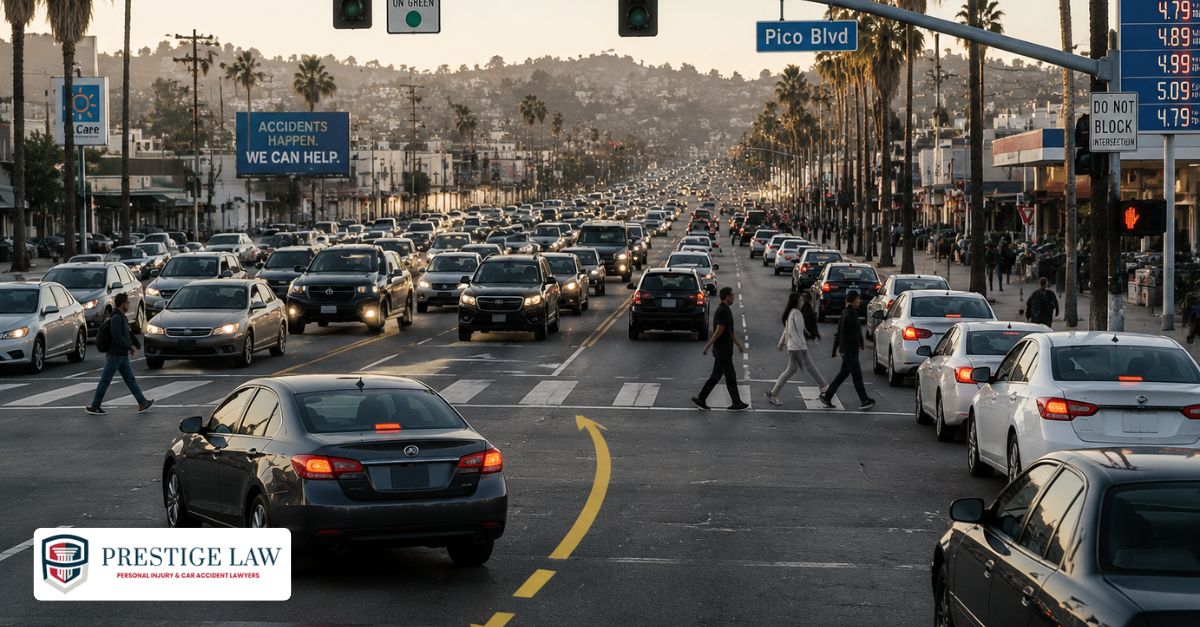
Left turns across wide, multi-lane roadways are one of the most dangerous movements at busy LA intersections.
Drivers must assess multiple lanes of oncoming traffic while also watching signals, pedestrians, and other turning vehicles. Small misjudgments can quickly lead to serious crashes.
- Turning across oncoming traffic leaves little margin for error
- Drivers often misjudge vehicle speed or closing gaps, especially during congestion
- Resulting crashes are frequently high-impact angle collisions rather than low-speed impacts
These collisions tend to cause more severe injuries because vehicles are struck from the side, where there is less structural protection.
Red-Light Running and Speed on the Approach
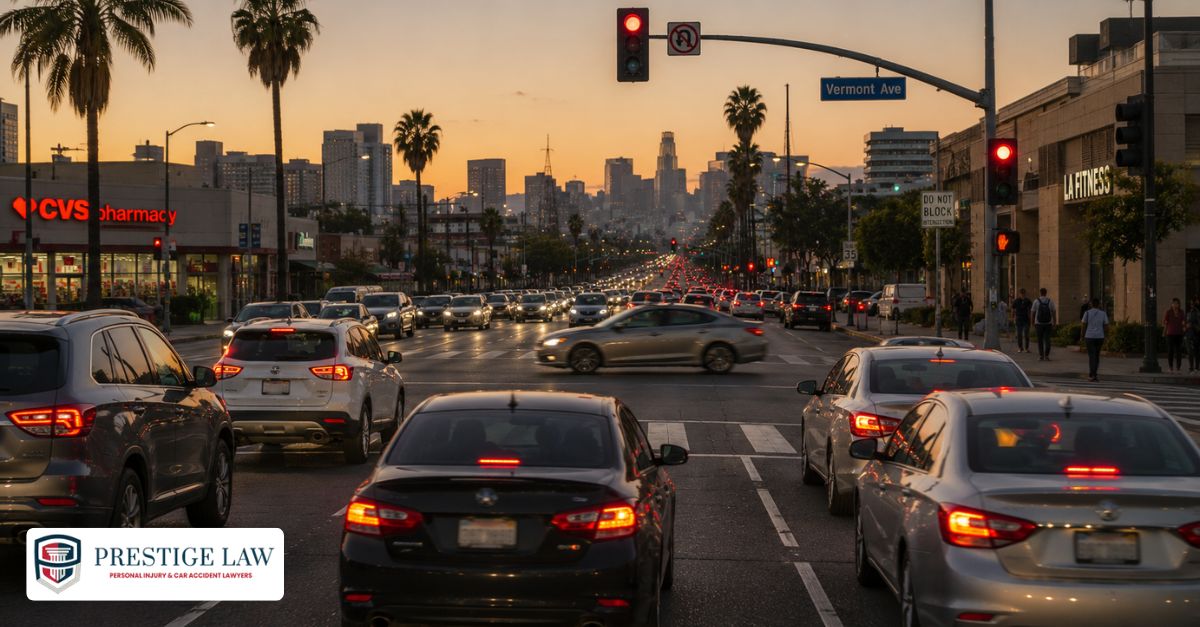
Speed and signal compliance play a major role in intersection crash severity across Los Angeles. Drivers approaching intersections at higher speeds have less time to react to changing lights, sudden stops, or turning vehicles. Crashes often occur when drivers attempt to clear an intersection after the signal changes or enter late during yellow-to-red transitions. These collisions tend to be especially severe because higher speeds increase impact force and reduce reaction time, particularly in side-impact crashes involving cross traffic.
Pedestrian and Cyclist Conflicts
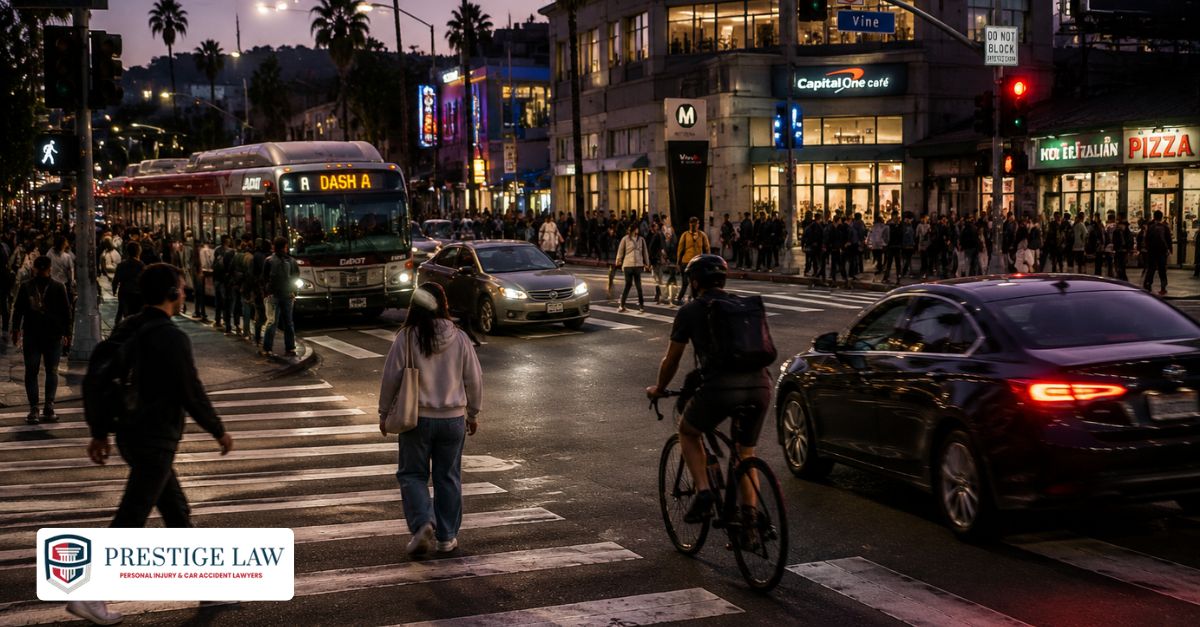
Many of the most dangerous intersections also serve as major pedestrian and transit hubs, increasing the likelihood of vehicle-to-pedestrian and vehicle-to-cyclist crashes.
- Long crosswalks increase exposure time for pedestrians
- Transit stops, schools, and nightlife zones generate steady foot and bike traffic
- Visibility is reduced at night, during peak hours, or when drivers are focused on turning movements
Pedestrians and cyclists have little physical protection, which is why collisions at these intersections often result in serious injuries even at moderate vehicle speeds.
How to Drive or Walk These Intersections More Safely
Here are practical steps drivers, pedestrians, and cyclists can use to reduce risk at Los Angeles’ most accident-prone intersections, where traffic volume, turning conflicts, and visibility issues make collisions more likely.
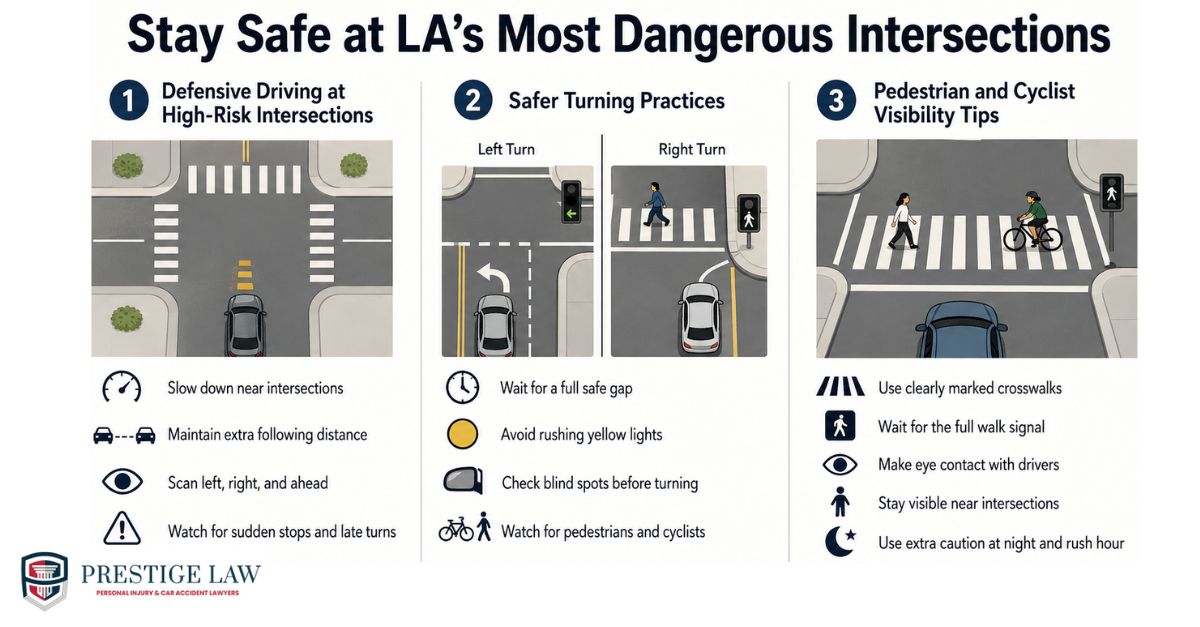
Defensive Driving at High-Risk Intersections
Approaching known crash hotspots with caution can reduce risk, even when you have the right of way. Slowing down as you near an intersection and maintaining extra following distance gives you more time to react to sudden stops, late turns, or unexpected lane changes.
Before entering on a green light, scanning left, right, and ahead helps catch drivers who may be entering late or attempting to beat the signal.
Anticipating that cross traffic may not stop fully, especially during yellow-to-red transitions, can prevent serious collisions that occur when drivers assume the intersection is clear.
Safer Turning Practices
Turning movements account for many serious intersection crashes. When making left turns, positioning your vehicle clearly in the turn lane and waiting for a full, safe gap reduces the risk of angle collisions.
Rushing a turn at the end of a signal cycle increases exposure to oncoming traffic and pedestrians already in the crosswalk.
For right turns, drivers should remain aware of pedestrians and cyclists traveling alongside the roadway, particularly those approaching from behind or entering crosswalks on a walk signal.
Slowing before turning and checking blind spots can prevent avoidable impacts.
Pedestrian and Cyclist Visibility Tips
Pedestrians and cyclists can reduce risk by crossing at clearly marked crosswalks and waiting for a full walk signal whenever possible. Making eye contact with drivers before entering the intersection helps confirm that you have been seen, especially when vehicles are turning.
Positioning yourself where drivers can easily see you, rather than alongside large vehicles or in blind spots, improves visibility. High-risk moments often occur at night, during rush hours, or near transit stops and entertainment areas, when driver attention may be divided. Extra caution during these periods can make a meaningful difference in safety.
What to Do After an Intersection Crash in Los Angeles
An intersection crash can be overwhelming, especially in busy Los Angeles traffic. The steps taken immediately afterward can affect health, documentation, and how the situation is addressed later. Here is what to focus on in the moments that matter most.
The First 10 Minutes — Immediate Checklist
The moments immediately following an intersection crash are critical for protecting both safety and accurate documentation. What happens during this short window can influence medical outcomes and how the incident is recorded. Staying calm and focusing on a few key priorities can make a meaningful difference.
Focus on the following steps if it is safe to do so:
- Seek medical attention first. Check yourself and others for injuries and call for emergency medical help if there is any pain, dizziness, or visible injury. Even symptoms that seem minor can appear or worsen hours or days later.
- Call law enforcement. Request that police respond to the scene so an official report can document the location, involved vehicles, parties, and initial observations.
- Document the scene. Use your phone to take photos and video of vehicle damage, license plates, traffic signals, lane markings, skid marks, debris, and the overall intersection layout.
- Collect witness information. If anyone saw the crash, ask for their name and contact information. Independent witnesses can help clarify what happened, especially in busy intersections where fault may be disputed.
- Exchange basic information. Share driver’s license, insurance, and vehicle details with the other parties involved, keeping communication factual and brief.
Evidence Preservation That Matters Later
Certain details become harder to recover as time passes. Clear photos of vehicle damage, roadway conditions, lane markings, and signal placement can help explain how the collision happened.
Medical documentation should be kept from the start, including emergency care, follow-up visits, and treatment recommendations, as these records link injuries to the crash.
Insurance communications, repair estimates, and receipts related to vehicle damage should also be organized, as they help document financial losses tied to the accident.
What Not to Do Right After the Crash
Certain actions taken immediately after a collision can complicate medical recovery and insurance handling. Avoid the following common mistakes:
- Do not give recorded statements right away. Insurance companies may request recorded statements before injuries are fully understood. Early statements can be incomplete or taken out of context.
- Do not speculate about fault. Avoid guessing what caused the crash or accepting blame at the scene.
- Responsibility is often not clear immediately, especially at complex intersections.
- Do not apologize or make casual remarks. Even polite or reflexive comments can be misinterpreted later as admissions of fault.
- Do not delay medical evaluation. Waiting to seek care can worsen injuries and make it harder to link symptoms to the crash.
- Do not leave the scene without documentation. Leaving before exchanging information or documenting the scene can limit your ability to clarify what happened later.
Staying focused on facts and health in the immediate aftermath helps protect both your well-being and the accuracy of the record.
Related Posts California Car Sleeping Laws: What Drivers Need to Know
When Legal Help Becomes Important After an Intersection Crash
Legal guidance often becomes important when an intersection crash involves more than minor vehicle damage. Serious or worsening injuries can require ongoing medical care, time away from work, and long-term documentation to fully understand their impact.
Disputed fault or shared blame is also common at intersections, where insurers may argue over signal timing, turning movements, or comparative negligence.
Delays, denials, or settlement offers that do not reflect medical costs or lost income can further complicate recovery. Crashes involving pedestrians, cyclists, rideshare vehicles, or work-related driving tend to involve additional legal and insurance layers, making early legal support especially useful.
How Prestige Law Firm P.C. Helps After Intersection Crashes
After an intersection crash, the legal process often becomes complex quickly, especially when injuries, disputed fault, or insurance pressure are involved. Prestige Law Firm P.C. provides focused support at each stage of the claim to help injured individuals protect their rights and navigate the process with clarity.
Key ways the firm assists include:
- Crash investigation and evidence review: Examining how the collision occurred by reviewing roadway conditions, vehicle damage, witness statements, and any available video or photographic evidence.
- Insurance communication management: Handling contact with insurance companies to limit recorded statements, reduce pressure on injured clients, and keep discussions aligned with documented facts.
- Medical documentation coordination: Organizing medical records, treatment timelines, and provider reports so injuries and ongoing care are accurately reflected and properly supported.
- Liability and damage analysis: Evaluating fault using crash details, medical evidence, and income loss information, including missed work and reduced earning capacity when applicable.
- Litigation readiness when needed: Preparing cases for litigation if an insurer refuses to evaluate the claim fairly, while keeping clients informed throughout the process.
Conclusion
Staying aware of high-risk intersections and understanding how crashes commonly occur can help drivers, pedestrians, and cyclists make safer decisions on Los Angeles roads. Awareness alone cannot prevent every collision, but informed choices such as slowing down, watching turning traffic, and staying visible can reduce risk in areas where serious crashes happen repeatedly.
When injuries occur or fault is disputed, knowing where to turn for guidance can make the process more manageable. Many people are unsure what steps matter most after a crash, especially when medical care, time away from work, or insurance pressure becomes involved. Seeking reliable information early can help protect both health and legal rights.
Prestige Law Firm P.C. car accident lawyers in LA serve injured individuals throughout Los Angeles County, including Van Nuys, Sherman Oaks, Reseda, Northridge, Palmdale, Lancaster, and surrounding communities.
As a local personal injury practice, the firm helps people navigate the aftermath of serious intersection crashes throughout Los Angeles County. When injuries, disputed fault, or insurance complications make recovery more difficult, early legal guidance can help preserve evidence, protect legal rights, and clarify the next steps.
What makes an intersection dangerous in Los Angeles?
An intersection is typically considered dangerous when it shows a pattern of frequent crashes, serious injuries, or fatalities. Factors often include high traffic volume, complex lane layouts, left-turn conflicts, speeding, and heavy pedestrian activity.
Are dangerous intersections always poorly designed?
Not always. Some intersections are risky because of traffic volume and driver behavior rather than design flaws. Others involve a combination of wide roadways, signal timing challenges, and frequent turning movements.
Do left turns cause more serious intersection crashes?
Yes. Left-turn crashes often result in angle or side-impact collisions, which tend to cause more severe injuries than rear-end crashes due to limited side protection in vehicles.
What should I do immediately after an intersection crash?
Seek medical attention, call law enforcement, document the scene with photos or video if safe, and collect witness contact information. Even minor symptoms should be evaluated.
Should I talk to the insurance company right away?
Basic information is usually required, but detailed or recorded statements can often wait until injuries and facts are better understood. Insurance communications should be handled carefully.
Who is usually at fault in intersection accidents?
Fault depends on the circumstances. Common causes include failure to yield, red-light violations, unsafe turns, or speeding. More than one party may share responsibility.
What if I was partially at fault for the crash?
California follows a comparative negligence system, meaning fault can be shared. Compensation may be adjusted based on each party’s percentage of responsibility.
How long do I have to file a claim after an intersection accident in California?
In California, most personal injury lawsuits must generally be filed within two years of the accident date. Claims involving government entities may involve significantly shorter notice deadlines.
What types of damages can be considered after a serious intersection crash?
Damages may include medical expenses, lost income, reduced earning capacity, property damage, and non-economic impacts such as pain and physical limitations.

Get Started Today!
24 hours a day / 7 days a week / 365 days a year
Contact our Los Angeles and Antelope team of attorneys for a free consultation.