

Legal Steps If You’re Sued After a Car Accident in California
Published on / Category: Insurance & Claims, Legal Rights & Process
Getting into a car accident is stressful enough—but getting sued afterward can feel overwhelming. Many drivers in California suddenly find themselves facing a lawsuit for damages, even if they weren’t entirely at fault.
If you’ve been served legal papers or suspect a claim is coming, it’s natural to feel anxious or confused. Questions about insurance, court deadlines, attorney fees, and financial risk can pile up fast.
But don’t panic—there are clear steps you can take to protect yourself. With the right legal guidance and timely action, you can defend your rights, limit your exposure, and navigate the situation with confidence.
At a Glance:
If you are sued after a car accident in California, act fast! Notify your insurer immediately, respond to the summons within 30 days, and consider hiring your own lawyer—especially if you're uninsured or the claim could exceed your coverage.
Insurance may provide a defense, but it doesn’t always cover everything. To avoid default judgments, wage garnishments, or personal financial exposure, seek legal guidance right away.
Prestige Law Firm offers free consultations to help you understand your rights and protect your future.

What It Means to Be Sued for a Car Accident in California
Getting sued after a car accident can be intimidating—but knowing what it really means helps you respond the right way.
In most cases, this type of lawsuit is a civil claim, not a criminal charge. That means the person suing you (the plaintiff) is asking for financial compensation—not jail time
You may be sued for:
- Medical bills
- Lost wages
- Vehicle damage
- Pain and suffering
Unless the accident involved a crime like DUI or reckless driving, you’re not at risk of criminal punishment. But if you ignore the lawsuit or fail to respond correctly, the court can enter a default judgment against you—which may lead to wage garnishment, damage to your credit, or personal asset seizure.
Understanding this early helps you make smart, timely decisions.
What Happens When You’re Sued
When someone sues you after a car accident in California, the legal process begins with something called service of process. You’ll be formally served with two key documents: a summons and a complaint.
These papers notify you that legal action has started and trigger a strict legal deadline. According to California Code of Civil Procedure § 412.20, the summons must include:
- The name of the court and both parties involved
- A clear instruction that you must respond in writing within 30 days
- A bold warning advising you to seek legal counsel immediately
- A standard legal notice stating:
“Unless the defendant so responds, his or her default will be entered… and the plaintiff may apply to the court for the relief demanded in the complaint, which could result in garnishment of wages, taking of money or property, or other relief.”
In plain terms: if you ignore the lawsuit or miss the 30-day deadline, the other party can win by default, and the consequences can be serious—from wage garnishment to personal asset seizure.
What should you do if someone sues you after a car accident?
Getting sued after a car crash is intimidating—but the actions you take right now can make a major difference. Whether the claim is fair or not, your response needs to be calm, clear, and legally strategic.
The most common mistakes? Ignoring the lawsuit, assuming your insurance will handle everything, or waiting too long to act.
Instead, you need to take charge early. Here’s how:
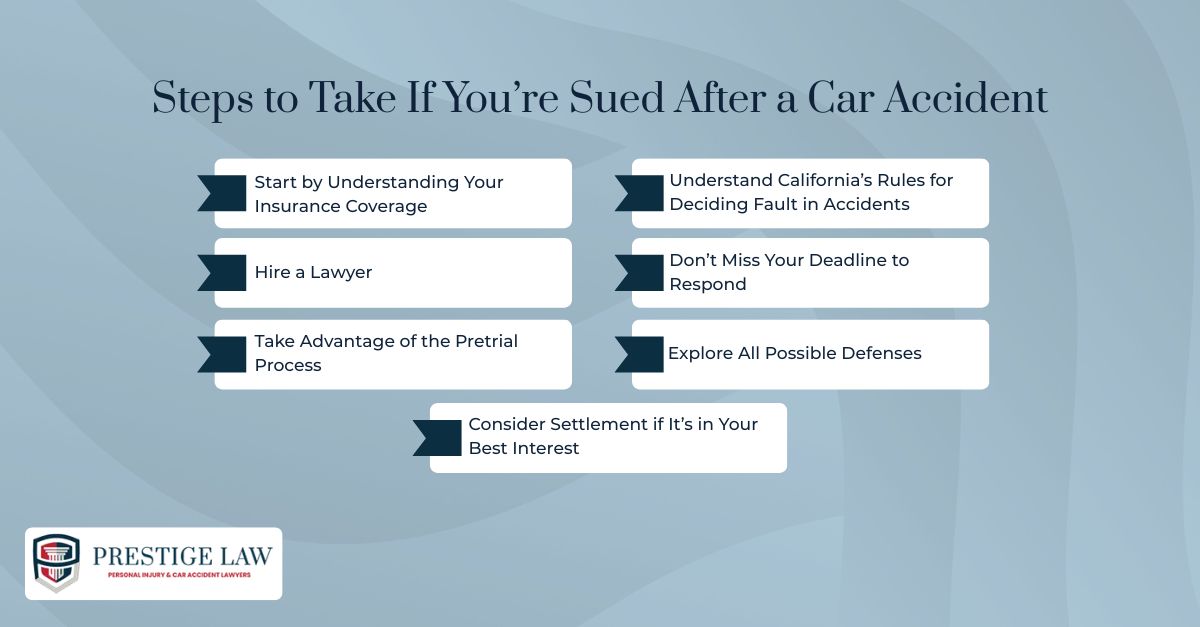
Start by Understanding Your Insurance Coverage
As of 2025, California increased its minimum auto liability insurance requirements. If you’re involved in a car accident, here’s what your policy must now include for any policy purchased or renewed after that date:
- $30,000 for injury or death to one person
- $60,000 for injury or death to more than one person
- $15,000 for property damage
If you’re insured, your provider may assign a lawyer and cover your legal defence—but only up to your policy limits.
However, insurance may not fully protect you if:
- The lawsuit seeks damages above your policy limits
- You were uninsured or underinsured
- The insurer disputes coverage due to a policy violation or coverage exclusion
It’s crucial to understand exactly what your policy includes and what it doesn’t. A qualified car accident defence lawyer can review your policy and help assess whether your financial exposure is fully covered—or if you need independent legal protection.
Understand California’s Rules for Deciding Fault in Accidents
California follows a fault-based system for car accidents. This means the person determined to be at fault for causing the crash is generally financially responsible for any resulting injuries or damages.
If you’re being sued, the plaintiff is claiming that your actions caused their losses—and they want compensation.
Here’s what matters:
- Fault isn’t always clear-cut. It’s possible that both drivers share blame.
- California uses comparative negligence, which means if the other driver is partially responsible, the amount they can recover may be reduced.
- Even small mistakes—like changing lanes without signaling—are among the most common causes of car accidents, and they can be used to argue fault in court.
Understanding how fault is determined helps you (and your lawyer) push back if the lawsuit is unfair or one-sided. Sometimes, proving the other party’s negligence—or shared fault—can significantly reduce or eliminate your liability.

Hire a Lawyer
If someone sues you for a car accident, and the case isn’t resolved through insurance, it may head to court. At that point, having the right lawyer can make all the difference.
Not all personal injury lawyers defend lawsuits—some only handle claims on behalf of injured plaintiffs. You need a lawyer who’s experienced in litigating car accident defence cases, not just negotiating quick settlements.
If you’re not sure where to start, consider these tips for choosing the best car accident lawyer—someone who knows how to defend cases in court, not just settle quickly.
Look for an attorney who:
- Has a strong track record of defending clients in court
- Understands California civil procedure and personal injury law
- Can evaluate the strength of the case against you and explain your options clearly
- Is willing to take the case to trial if needed
Your lawyer will review the complaint, assess potential defences, file a timely response, and start building your legal strategy. If you’re uninsured, underinsured, or facing serious financial exposure, independent legal representation is essential—not optional.
Don’t Miss Your Deadline to Respond
Once you’re officially served with a lawsuit—typically through in-person delivery or certified mail—you’re on the clock. In California, you generally have 30 days from the date of service to file a written response with the court.
If you miss this deadline, the court can enter a default judgment against you. That means the other party could win the case automatically, and you could face serious financial consequences, including:
- Wage garnishment
- Seizure of personal assets
- Damage to your credit
Your attorney will help you prepare and file the proper response on time. Even if you’re still reviewing your options or unsure about liability, never ignore a summons—the clock doesn’t stop ticking.

Take Advantage of the Pretrial Process
After both sides have filed their paperwork, the lawsuit enters a phase called discovery. This is your opportunity to gather evidence, challenge the plaintiff’s claims, and build a strong defence—before the case ever reaches a courtroom.
During discovery, your legal team can:
- Request documents, medical records, and repair estimates from the other side
- Submit written questions (called interrogatories)
- Schedule depositions to question witnesses and the plaintiff under oath
- Uncover inconsistencies or weaknesses in the other party’s version of events
Many cases are won—or settled—during this phase. A well-executed discovery process can pressure the plaintiff to reduce their demands, settle fairly, or even drop the case altogether.
Explore All Possible Defenses
Just because you’ve been sued doesn’t mean the case against you is solid. With the right legal guidance, you may be able to get the lawsuit dismissed, reduced, or resolved in your favor.
Some common defences include:
- Statute of limitations: In California, the deadline to file a personal injury claim is generally two years from the date of the accident. If the plaintiff filed late, the case may be dismissed.
- Comparative negligence: If the other party contributed to the crash—by speeding, running a red light, or texting while driving—their compensation could be reduced.
- Failure to mitigate damages: If the plaintiff didn’t seek timely medical care or ignored medical advice, their claim for damages might be challenged.
- Lack of causation: Your lawyer may argue that the injuries weren’t caused by the accident—or not by your actions specifically. It’s the plaintiff’s burden to prove otherwise.
An experienced attorney can assess which defences apply and develop a strategy to protect your finances, record, and reputation.

Consider Settlement if It’s in Your Best Interest
Not all lawsuits go to trial. In fact, most car accident cases in California are resolved through settlement—often during or after the discovery process.
A settlement means both sides agree to resolve the case without a trial. This can be a smart option if:
- The evidence is strong on both sides
- The cost of going to court outweighs the potential benefit
- You want to avoid the stress, time, and uncertainty of trial
- Your attorney has gathered solid evidence to challenge or reduce the claim
Settling doesn’t mean admitting fault—it means protecting your finances, limiting your risk, and moving on with your life. A good attorney will negotiate aggressively on your behalf and only recommend settlement if it truly benefits you.
When to Hire a Lawyer Independently
In many car accident lawsuits, your insurance company will appoint a lawyer to represent you as part of your liability coverage. But that doesn’t always mean you’re fully protected.
There are situations where hiring your own attorney—separate from the insurance company—is the smartest move.
If You’re Uninsured or Not Adequately Represented
If your insurance has lapsed or you weren’t covered at the time of the accident, you’re personally responsible for defending the lawsuit—and for any damages awarded. Without legal representation, you’re at serious financial risk.
Even if you do have insurance, the lawyer your insurer assigns is working to protect the company’s interests, not necessarily yours. If the case involves:
- Claims not fully covered by your policy
- A possible conflict of interest
- A lack of communication or poor defense strategy
…then it’s time to consider hiring independent counsel to ensure your personal rights and financial future are properly defended.

If There Are Conflicts with Your Insurance Company
Sometimes, your insurance company might dispute coverage altogether—especially if:
- The claim involves an intentional act
- You allegedly violated policy terms
- The damages exceed your policy limits
In these situations, your insurer may send a “reservation of rights” letter—which means they may later deny coverage or walk away from your defense.
When that happens, you may be entitled to choose independent counsel, sometimes at the insurer’s expense. A skilled attorney can also help challenge denied claims, negotiate directly with the plaintiff, or even sue your insurer for bad faith if necessary.
If You’re Worried About Financial Exposure or Your Record
Even if you share only partial fault, a court judgment can affect much more than just your wallet. You could face:
- Garnished wages or frozen assets
- A judgment on your credit report
- Increased insurance premiums
- Employment issues if a civil judgment appears during background checks
Your own attorney will work to minimize financial fallout, push for early settlement if appropriate, and protect your reputation—both in and out of court.
Why Choose Prestige Law Firm
If you’re being sued after a car accident in California, you need more than just legal help—you need someone who understands what’s at stake for you, your family, and your future.
At Prestige Law Firm, we specialize in defending clients facing serious legal and financial consequences after an accident. Whether you’re uninsured, underinsured, or unsure what to do next, we’re here to guide you every step of the way.
Here’s what sets us apart:
✅ Over two decades of experience handling complex personal injury and defense cases
✅ Direct access to lead attorney Paul Aghabala, not junior staff
✅ Expertise in both civil lawsuits and workers’ compensation cross-over claims
✅ Proven results, including seven- and eight-figure settlements and verdicts
✅ A strong presence in Van Nuys, Palmdale, and communities across Los Angeles County
✅ A client-first approach: We don’t just represent you—we fight for you
We’ve helped countless Californians avoid devastating financial losses, challenge unfair claims, and protect their future—even when insurance companies tried to back away.
And with our no recovery, no fee policy, there’s no risk in reaching out.
📞 Call us today at (818) 788-0808 or (661) 341-3939
📧 Email: paul@prestigelaw.com
Serving Van Nuys, Palmdale, and all of Southern California
Conclusion
Being sued after a car accident can feel overwhelming—but you don’t have to face it alone. With the right legal strategy, you can take control of the situation, protect your finances, and move forward with confidence.
Whether you’re insured, uninsured, or unsure what your options are, early action is critical. The steps you take now can shape the entire outcome.
Prestige Law Firm is here to help. With decades of experience, local insight, and a client-first approach, we’re ready to defend your rights and help you move forward.
Reach out today for clear answers and strong representation.
Can I be sued personally for a car accident?
Yes. If someone believes you caused the accident, they can sue you directly—even if you have insurance.
What should I do if I receive a summons for a car accident?
Respond within 30 days, notify your insurer immediately, and contact a lawyer to avoid a default judgment.
Can I go to jail for a car accident in California?
Only if the crash involved a crime, like DUI, reckless driving, or a hit-and-run.
How long does someone have to sue after a car accident in California?
Two years for personal injury claims; three years for property damage.
Will my insurance cover me if I’m being sued?
Usually yes, up to your policy limits—but you may still need your own attorney for full protection.

Get Started Today!
24 hours a day / 7 days a week / 365 days a year
Contact our Los Angles and Antelope team of attorneys for a free consultation.